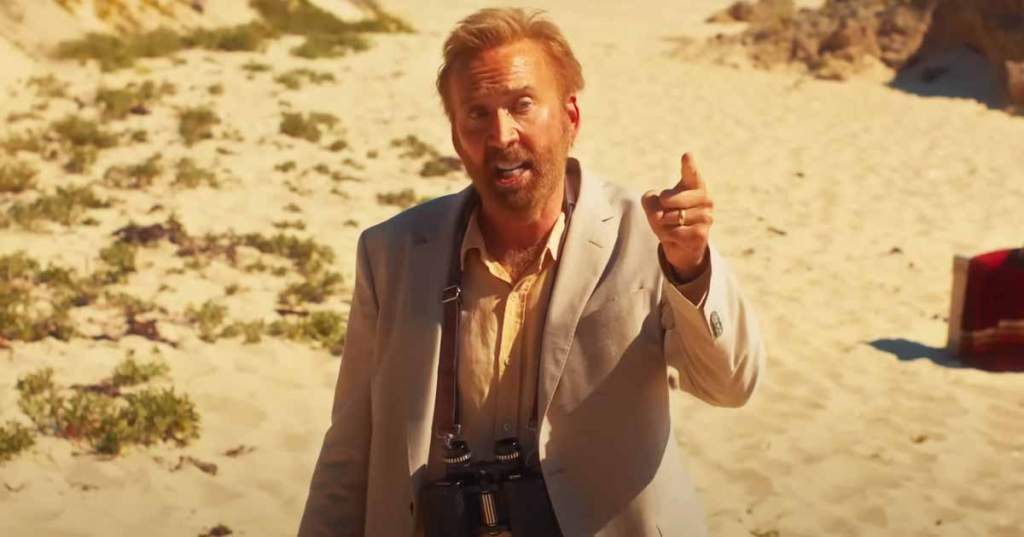
In a burst of procrastinatory creativity, I’ve written a short ‘review’ of the The Surfer (Lorcan Finnegan, 2024). (Originally published over at Letterboxd.com, but reproduced here.)
There’s an apocryphal story about an early Australian screening of Wake in Fright, supposedly attended by one of the film’s stars, Jack Thompson in 1971. Legend has it that local audiences had been rankling at the representations of Australians thrown up on screen, prompting a man to stand up and shout “that’s not us!”, to which Thompson replied: “yes it bloody well is, now sit down!” Maybe I’ve been too long on this side of the planet, but this particular Aussie country boy – who recognised every single frame of Wake in Fright’s sun-scorched and dustblown picaresque, and the violent hospitality that governs small, isolated Australian towns – felt an abiding urge to stand up during The Surfer and make a similar declaration of denial.
Both films are the work of ‘outsiders’. But where the Canadian Ted Kotcheff headed into the ‘unknown’ (in a cinematic sense, at least) to make Wake in Fright, the Irish Lorcan Finnegan made The Surfer very much in the wake of Australian genre cinema’s flourishing, and – of course – its recent resurrection in the retrospective image of ‘Ozploitation’. And there’s no doubting the influence of both Wake in Fright and subsequent Australian genre films here – not least Long Weekend, a film written by another ‘outsider’, Everett de Roche – but The Surfer feels all too much like pastiche to me.
Worse, while the best Ozploitation films – from Wake in Fright onwards – were able to sketch human monsters of some complexity, The Surfer feels weighted down by unlikeable, one-dimensional goons, from Nicolas Cage’s tortured rich guy, to the ‘yuppies cosplaying as surf bums’ against whom he is pitted. The violent, exclusionary localism of Julian McMahon’s Scally (and his gang) is almost the polar opposite of the desperate inhabitants of Wake in Fright‘s Bundanyabba. Both the ‘Yabba and this secluded beach are hotbeds of toxic masculinity, but whilst one felt dangerously rooted in place and desperate for connection, the other seems to only offer vague jabs at personal liberty and the masculinist poison of online influencers.
And that’s to say nothing of the whiteness of it all. Settler colonial scholars often talk about culture’s role in ‘indigeneizing’ the settler, and The Surfer pivots on particularly odd, and oddly unreconstructed, questions of who is welcome and who is not (a particularly hot button topic in Australia right now, although there are obviously also shades of the Cronulla Riots). I’m still trying to wrap my head around the vague allusions to Aboriginal white ochre ceremonial facepaint, and the baffling presence of Miranda Tapsell as a visiting photographer, the only ‘normal’ character for miles.
There can be no doubting that Australian beach carpark’s are particularly hellish places, but whilst I sometimes joke that Wake in Fright feels like a documentary, everything here feels fabricated. Except, perhaps, that this is a film about a man trying to buy a beachfront property. As a cinematic representation of getting on the property ladder in Australia, maybe the existential hellishness of The Surfer is quite accurate, after all.
The Surfer is in US cinemas on 2 May (via Roadside Attractions/Lionsgate), and UK cinemas on 9 May (via Vertigo). Madman release the film in Australian cinemas on 15 May, with a streaming release on Stan from 15 June.
 Dr Stephen Morgan